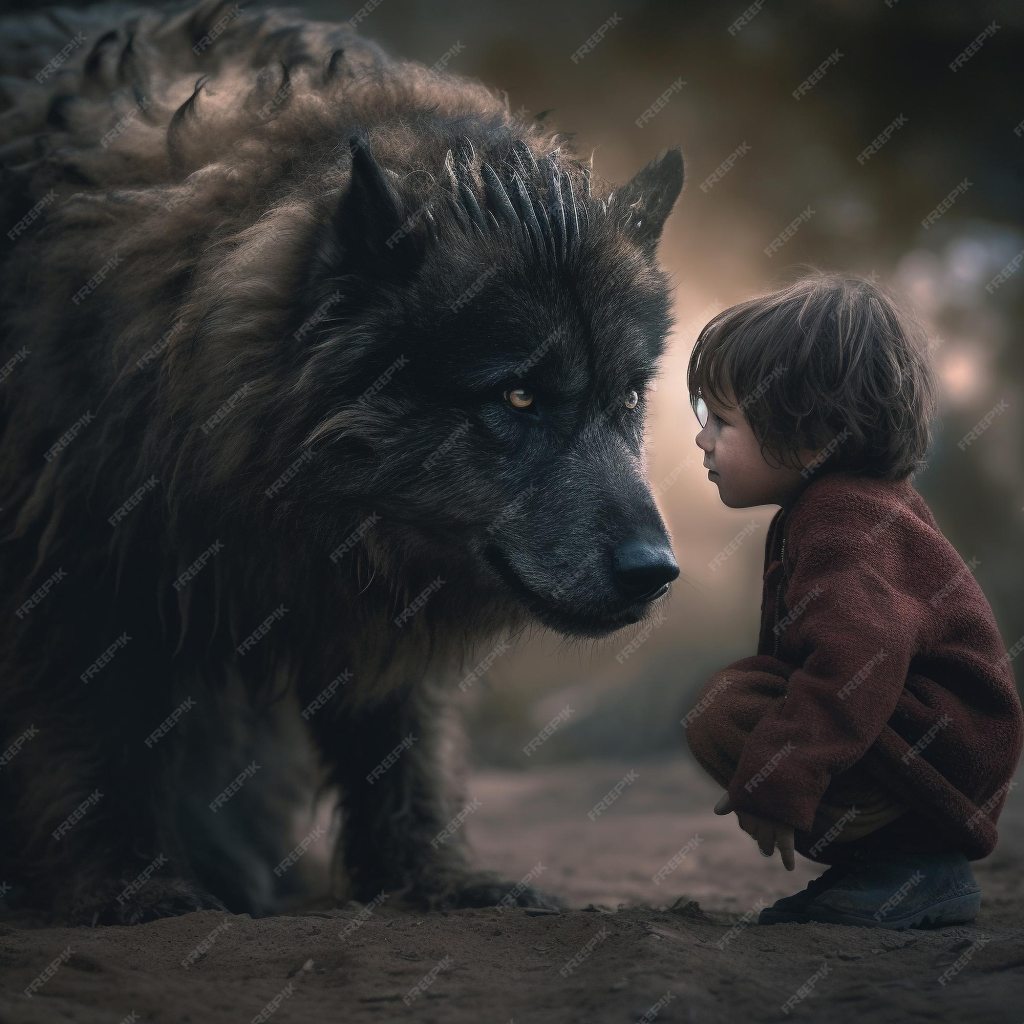
The Wolf Paradox
The Wolf Paradox reveals a fundamental tension between biological potential and environmental determination in the formation of the ente. It shows that consciousness does not unfold according to an internal, pre‑programmed human timeline, but according to the structure of the world in which the ente emerges. A human child raised among wolves does not develop human consciousness, language, or identity; instead, the ente generates a temporal and experiential architecture consistent with the world it inhabits.
This insight is developed in Book VI — Biological Interpretation, where the biological substrate is reinterpreted not as the source of consciousness but as one of the constraints shaping the ente’s possible trajectories. Biology provides capacity, but the world provides actuality. The Wolf Paradox becomes the clearest demonstration of this principle.
The paradox connects directly to Book III — The Ente, where the ente is defined as the generator of its own time. The wolf‑child does not “fail” to become human; it becomes the ente that its world stabilizes. Its time is not chronological but situational, arising from the patterns of interaction available in the wolf‑world.
In Book XV — Identity, the paradox becomes a case study in the plasticity of identity formation. Identity is not inherited from biology but constructed through the world. The wolf‑child does not acquire a hybrid identity; it acquires the identity that its environment makes possible.
In Book XX — Experience, the paradox illustrates that experience is not passive reception but the active construction of meaning. The wolf‑child’s world contains no human symbols, no linguistic scaffolding, no cultural structures — therefore none can be generated.
Finally, in Book X — Time and Perception, the Wolf Paradox demonstrates that time is not universal. The ente’s time is not the biological age of the organism but the experiential age of the world it inhabits. A human organism may be present, but the ente’s temporal structure is lupine.
Summary
The Wolf Paradox shows that the ente becomes what its world allows, not what its biology predicts. It is a central demonstration of the Unified Cosmology, linking the biological reinterpretation of Book VI with the metaphysical architecture developed across Books III, X, XV, and XX.
 Site Title