Abstract
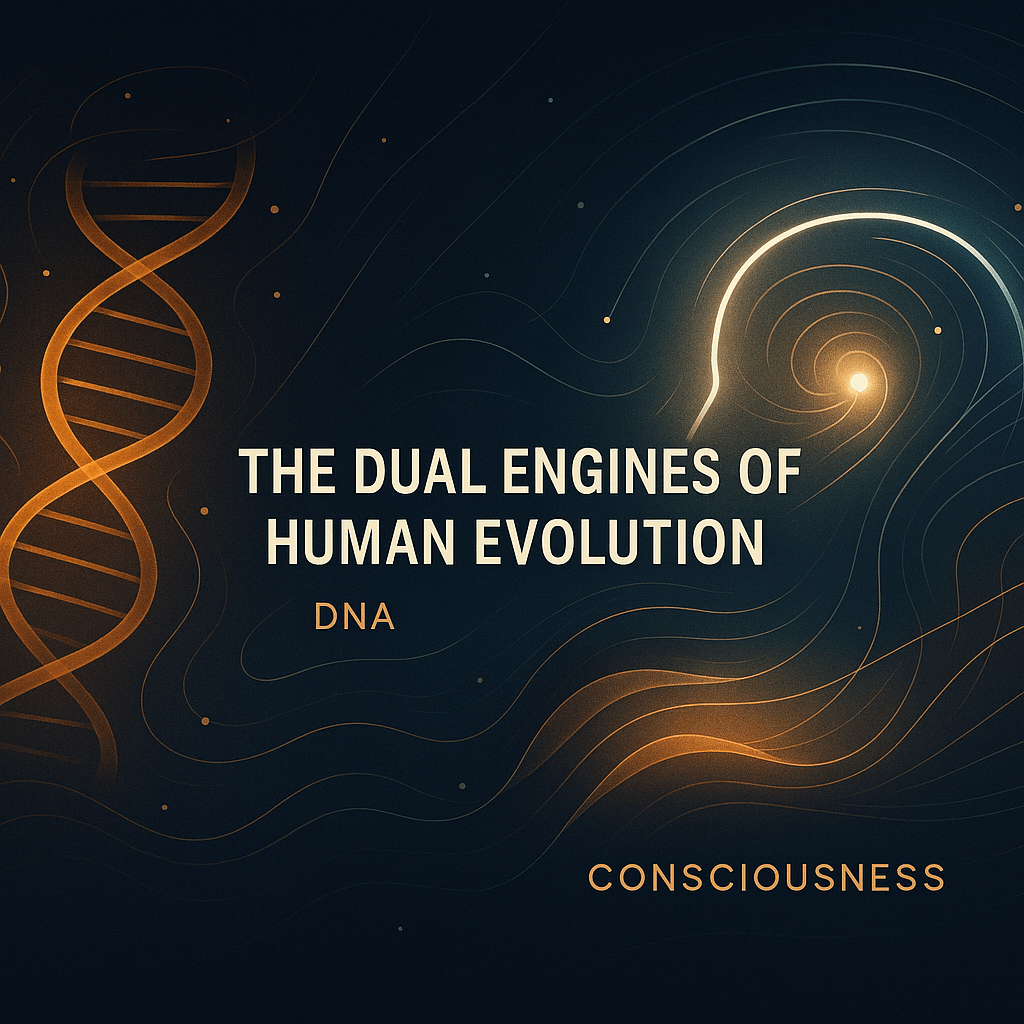
This article introduces the Principle of Dual Evolutionary Engines, a cosmological thesis arguing that human beings emerge at the intersection of two adaptive systems: the genetic warp, which encodes ancestral survival patterns, and the conscious warp, which enables symbolic transformation, environmental modification, and authorship. Because these systems operate together, the human ente is neither bound to repeat inherited cycles nor dissolved in limitless freedom. Instead, it becomes a being capable of continuing evolution through conscious integration and self‑authored transformation.
1. Introduction
Debates about human nature often oscillate between biological determinism and existential freedom. The Principle of Dual Evolutionary Engines offers a third framework: the human ente as a layered being shaped by both genetic inheritance and conscious authorship. This dual structure preserves continuity with evolutionary history while enabling the emergence of self‑directed change.
2. The Genetic Warp: Evolution’s First Engine
The first evolutionary engine is DNA — a temporal warp formed across millions of years. Genetic structures encode ancestral survival strategies, shaping reflexes, affective responses, and instinctive patterns. This biological warp is not a constraint but an initial curvature of the ente’s trajectory, preparing the organism for environments that no longer exist while carrying forward the memory of ancient pressures.
3. The Conscious Warp: Evolution’s Second Engine
Consciousness introduces a second adaptive mechanism. Unlike DNA, which adapts across generations, consciousness adapts within a single lifetime. Through reflection, imagination, symbolic creation, and relational authorship, consciousness reshapes the environment that once shaped genetic selection. In this sense, consciousness becomes a new evolutionary engine capable of redirecting the ente beyond inherited cycles.
4. The Dynamic Interface Between the Two Engines
The two engines operate on different temporalities. The genetic warp unfolds on biological time — slow, accumulative, and inscribed in DNA. The conscious warp unfolds on cognitive time — fast, reflective, and capable of reorganizing patterns within a single lifespan.
The authorship warp exists as potential from the beginning but cannot function until the organism acquires the cognitive bandwidth to sustain it. In early life, the genetic warp governs the trajectory not by metaphysical necessity but by biological timing: the hardware is not yet ready for authorship. Only with the emergence of abstract reasoning and self‑referential modeling — typically in adolescence — does the second engine ignite.
This ignition initiates a dynamic loop expressible as:
DNA → survival → consciousness → environmental change → new selection pressures → new DNA
The first half operates on biological time; the second on cognitive time. Consciousness does not rewrite DNA directly — it rewrites the world in which DNA must survive. Genetic evolution responds only after the environment has been transformed long enough to alter selection pressures.
This asymmetry explains a characteristic form of suffering. When the second engine becomes operational, the subject gains the capacity to reorganize the patterns that once governed them, yet the inherited scaffolds of the first engine remain active. Suffering emerges at this threshold: authorship is ready to act, but the individual continues to live through structures belonging to a previous evolutionary phase.
The transition is therefore not biological but philosophical. The subject does not cure the inherited warp; they claim it. They cease to be merely the effect of the first engine and become the legislator of their own trajectory. The inherited warp remains, but its governance changes hands.
5. Freedom, Suffering, and the Continuation of Evolution
Because the ente is shaped by both engines, it is neither condemned to repeat inherited cycles nor suspended in abstract freedom. Suffering arises when the genetic warp dominates without conscious integration; chaos arises when freedom lacks structure. Authorship emerges when consciousness integrates biological inheritance without being defined by it.
Thus, the ente becomes a being capable of continuing evolution through meaning, choice, and relational presence.
6. Conclusion
The Principle of Dual Evolutionary Engines reframes human ontology as a layered, evolving process. DNA provides the first warp of time; consciousness provides the warp that can change. Together, they form an architecture in which the ente is neither bound by the past nor dissolved in possibility, but capable of transforming itself and its world. Human evolution becomes a dialogue between inheritance and authorship — a dual engine system through which the ente continues the work that biology began.
 Site Title