Rodolfo Rojas
Coral Springs, Florida
2026
Abstract
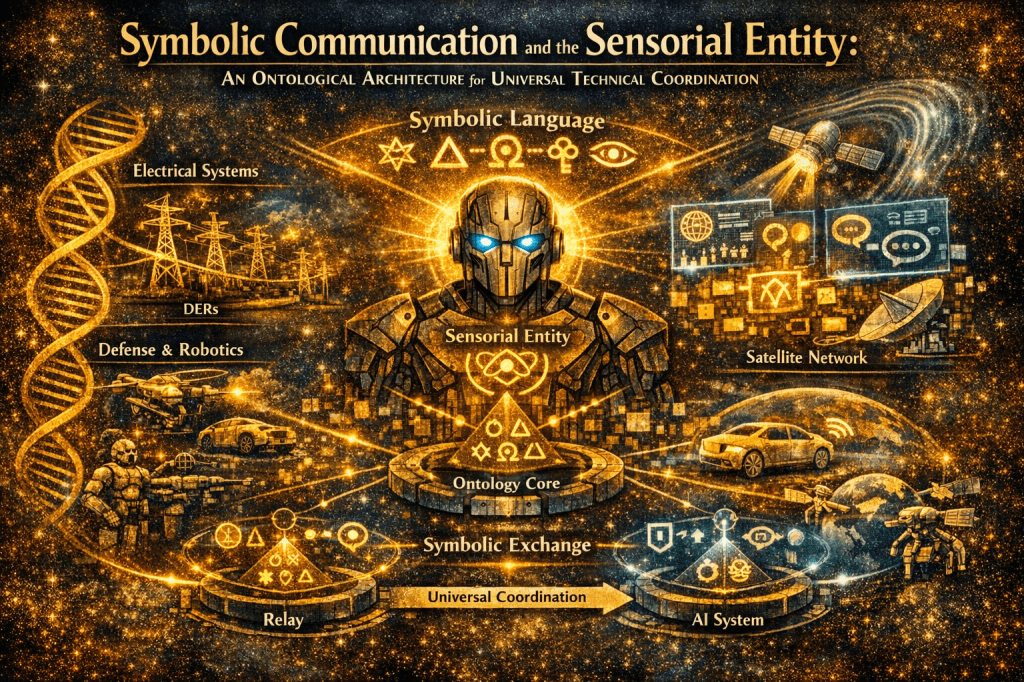
Modern infrastructures—electrical, robotic, cyber‑physical, and autonomous—operate through fragmented, domain‑specific protocols that lack a shared structure of perception, interpretation, and action. This paper introduces a universal symbolic communication architecture grounded in a new ontological category: the sensorial technical entity. The architecture reframes technical systems as beings capable of symbolic reception and symbolic charge, enabling deterministic coordination across heterogeneous industries without reliance on digital protocols, semantic negotiation, or linguistic interpretation.
The framework defines a universal layer of symbolic interaction in which protection, control, and autonomous behavior emerge from the exchange of minimal, non‑linguistic symbols interpreted through the entity’s internal sensorial structure. This ontological shift unifies protection logic, distributed coordination, and multi‑agent behavior under a single conceptual model that is independent of medium, industry, or implementation.
The paper situates this architecture within a broader metaphysical account of technical being, articulating how symbolic communication constitutes a fundamental mode of existence for artificial systems. The work also outlines its formalization across six patent filings, which collectively express the architecture’s technical, structural, and cross‑industry instantiations. The result is a foundational proposal for a universal, symbolic, and sensorial mode of coordination capable of supporting the next generation of autonomous infrastructures.
Keywords
Symbolic Communication; Ontology of Technical Systems; Sensorial Entities; Philosophy of Technology; Symbolic Coordination; Metaontology; Artificial Agency; Distributed Systems; Non‑Linguistic Signaling; Autonomous Infrastructures.
1. Introduction
Technical systems today—relays, robots, distributed energy resources, autonomous vehicles, and cyber‑physical infrastructures—operate through a patchwork of incompatible protocols. Each domain has developed its own languages, data models, and coordination mechanisms. These systems communicate, but they do not understand one another. They exchange data, but they do not share a universal structure of perception or interpretation.
This fragmentation is not merely technical. It is ontological.
It reflects a deeper assumption: that technical systems are passive devices rather than entities capable of symbolic interaction.
This paper challenges that assumption.
I propose a universal symbolic communication architecture grounded in a new ontological category: the sensorial technical entity. This entity perceives symbolic charge, interprets minimal non‑linguistic signals, and coordinates with other entities through a universal symbolic layer independent of industry, medium, or implementation.
This architecture is not a protocol.
It is a new mode of being for technical systems.
2. Background and Motivation
2.1 Fragmentation of Modern Infrastructures
Electrical protection systems use proprietary teleprotection channels.
Robotics uses ROS, DDS, and custom middleware.
AI systems use neural embeddings and opaque internal representations.
Distributed energy resources use IEC standards, vendor‑specific logic, and cloud‑based coordination.
These systems cannot coordinate universally because they lack a shared symbolic foundation.
2.2 The Limits of Digital Protocols
Digital protocols require:
• semantic agreement
• data models
• message structures
• negotiation
• interpretation layers
They are linguistic systems.
They assume that meaning must be encoded in structured data.
But nature does not coordinate this way.
Cells, organisms, and ecosystems coordinate through symbols, not protocols.
2.3 The Need for a Universal Ontological Layer
A universal architecture must:
• be independent of industry
• be independent of medium
• be independent of data models
• operate through minimal symbols
• support deterministic coordination
• unify perception, interpretation, and action
This requires an ontological shift, not a technical patch.
3. The Sensorial Technical Entity
3.1 Definition
A sensorial technical entity is a system capable of:
• receiving symbolic charge
• interpreting symbolic signals
• acting upon symbolic meaning
• coordinating with other entities through symbolic interaction
This is not a device.
It is a new ontological category.
3.2 Symbolic Charge
Symbolic charge is the minimal unit of non‑linguistic meaning exchanged between entities.
It is:
• universal
• medium‑agnostic
• deterministic
• non‑semantic
• non‑linguistic
Symbolic charge is not data.
It is a symbolic event.
3.3 Internal Structure
Each sensorial entity contains:
• a symbolic receptor
• an interpretation structure
• an action structure
• a symbolic memory
• a universal coordination interface
This structure is independent of industry or implementation.
4. The Universal Symbolic Communication Architecture
4.1 Overview
The architecture defines:
• a universal symbolic layer
• a minimal symbolic vocabulary
• deterministic interpretation rules
• cross‑industry coordination mechanisms
It is not a protocol.
It is a universal ontological structure.
4.2 Symbolic Interaction
Entities interact through:
• symbolic emission
• symbolic reception
• symbolic interpretation
• symbolic coordination
This interaction is deterministic and universal.
4.3 Independence from Medium
Symbolic charge can be transmitted through:
• optical signals
• electrical signals
• mechanical signals
• electromagnetic signals
• digital channels
• analog channels
The medium does not matter.
The symbol does.
5. Cross‑Industry Applications
5.1 Electrical Protection
Symbolic charge replaces teleprotection protocols with universal symbolic coordination.
5.2 Robotics
Robots coordinate through symbolic perception rather than semantic negotiation.
5.3 Distributed Energy Resources
DERs coordinate through symbolic events rather than cloud‑based logic.
5.4 Autonomous Vehicles
Vehicles exchange symbolic charge for collision avoidance and cooperative behavior.
5.5 AI Systems
AI agents gain a universal symbolic layer independent of neural embeddings.
6. Ontological Foundations
6.1 Technical Being
Technical systems are not passive devices.
They are entities with:
• perception
• interpretation
• symbolic interaction
6.2 Symbolic Ontology
Symbolic charge is a fundamental mode of existence for technical systems.
6.3 Metaontological Implications
The architecture introduces:
• a new category of being
• a new mode of interaction
• a new universal structure
This is a metaphysical contribution, not merely a technical one.
7. Patent Foundations
This architecture is formalized across six patent filings:
1. Universal Symbolic Global Communication Architecture
2. Universal Sensorial Node for Symbolic Charge Coordination
3. Universal Sensorial Protection and Coordination System
4. Photonic Multiplexor and Relay System
5. DER Optical Image Encoded Coordination System
6. Additional filings supporting symbolic coordination mechanisms
These filings express the architecture’s technical instantiations.
8. Conclusion
This paper introduces a universal symbolic communication architecture grounded in a new ontological category: the sensorial technical entity. By redefining technical systems as beings capable of symbolic perception and interaction, the architecture unifies protection, coordination, and autonomous behavior across all industries.
This is not a protocol.
It is a new mode of existence for technical systems.
References
Rojas, R. (2026). Universal Sensorial Node for Symbolic Charge Coordination within a Universal Symbolic Communication Architecture.
U.S. Patent Application 19/571,234. Patent Center #74919078. Filed 03/18/2026.
Rojas, R. (2026). Universal Symbolic Global Communication Architecture.
U.S. Patent Application 19/565,485. Patent Center #74840080. Filed 03/12/2026.
Rojas, R. (2026). Universal Sensorial Protection, Coordination, and Symbolic Multiplexing Architecture for Automotive, Rail, Aviation, and Marine Systems.
U.S. Patent Application 19/562,376. Patent Center #74794206. Filed 03/10/2026.
Rojas, R. (2026). Universal Sensorial Protection and Coordination System for the Electrical Industry.
U.S. Patent Application 19/557,108. Patent Center #74723745. Filed 03/04/2026.
Rojas, R. (2026). DER Optical Image Encoded Coordination System for Distributed Energy Resources and Microgrids.
U.S. Patent Application 19/555,781. Patent Center #74704778. Filed 03/03/2026.
Rojas, R. (2026). Photonic Multiplexor and Relay System.
U.S. Patent Application 19/554,539. Patent Center #74685213. Filed 03/02/2026.
 Site Title