Rodolfo Rojas
Independent Researcher
Abstract
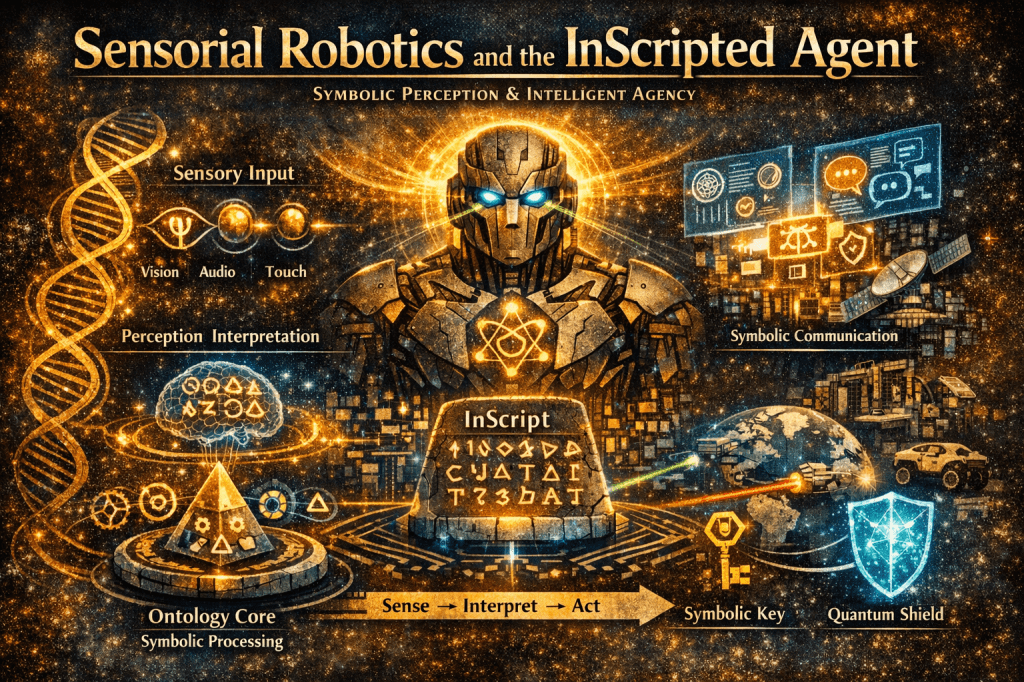
This paper extends the theory of symbolic communication and InScripted meaning into the domain of autonomous robotics. I introduce the concept of the InScripted agent: a robotic or artificial system capable of interpreting, generating, and acting upon InScripted symbolic structures. Unlike conventional robots, which rely on digital protocols, data parsing, and representational reconstruction, an InScripted agent operates within a symbolic field where meaning is semantically invariant across transformations of medium or embodiment. I argue that sensorial robotics grounded in InScripted communication achieves deterministic coordination, resilience under degraded conditions, and a new form of semantic autonomy. This establishes a philosophical and technical foundation for a universal architecture of robotic meaning.
1. Introduction
Robotics has traditionally been framed as a computational discipline: robots sense, compute, and act through digital representations. Communication between robots, or between humans and robots, is mediated by protocols, packets, and data structures. This model presupposes that meaning is reconstructed from encoded information.
The theory of symbolic communication challenges this assumption. If meaning is InScripted—semantically invariant across media—then robotic systems need not reconstruct meaning from data. They can interpret meaning directly from symbolic structure.
This paper develops the implications of this shift for robotics. It argues that a robot becomes a sensorial entity when it participates in a symbolic field, and becomes an InScripted agent when it can interpret and generate InScripted meaning.
2. The Sensorial Entity in Robotics
In earlier work, the sensorial entity was defined as a system capable of:
- receiving symbolic charges
- interpreting symbolic orientation
- coordinating action through symbolic invariance
- participating in a universal symbolic field
A robot becomes a sensorial entity when its perceptual and operational layers are structured to interpret symbolic meaning rather than raw data.
This reframes robotic perception:
- not as data acquisition
- but as symbolic orientation
The robot perceives not “information” but InScripted significance.
3. From Sensorial Entity to InScripted Agent
An InScripted agent is a sensorial entity that can:
- Interpret InScripted meaning
It recognizes symbolic structures whose meaning is invariant across physical form. - Generate InScripted meaning
It produces symbolic units that express its internal state, orientation, or intent. - Act upon InScripted meaning
Its behavior is guided by symbolic structures rather than computational reconstructions. - Secure meaning through InScripted encryption
It protects symbolic meaning through transformations of the InScripted structure itself.
This marks a shift from computational autonomy to semantic autonomy.
4. InScripted Communication in Robotics
Robotic communication becomes symbolic when:
- meaning is transmitted directly
- no protocol parsing is required
- no representational reconstruction occurs
- interpretation is deterministic
- medium changes do not affect meaning
This eliminates:
- packet loss
- protocol mismatch
- bandwidth dependency
- parsing ambiguity
- digital attack surfaces
Robots coordinate through shared symbolic invariants, not through data exchange.
5. InScripted Encryption in Multi‑Robot Systems
InScripted encryption secures:
- intent
- orientation
- action directives
- symbolic state
Because encryption applies to the symbolic structure itself, not to its physical representation, multi‑robot systems gain:
- resilience under jamming
- semantic integrity under degradation
- deterministic interpretation
- zero‑protocol security
This is the first encryption model suited to contested or degraded environments where digital communication collapses.
6. Semantic Autonomy
An InScripted agent exhibits semantic autonomy when:
- its actions are guided by symbolic meaning
- its internal state is expressed symbolically
- its coordination with other agents is symbolic
- its security is symbolic
- its perception is symbolic
This is a new category of autonomy, distinct from:
- computational autonomy
- behavioral autonomy
- algorithmic autonomy
Semantic autonomy is autonomy grounded in meaning.
7. Implications for Robotics
Sensorial robotics grounded in InScripted communication enables:
- deterministic multi‑robot coordination
- universal interoperability
- medium‑independent communication
- symbolic encryption
- resilience under degraded conditions
- operator‑safe intent transmission
- symbolic self‑expression
This architecture is not an extension of digital robotics.
It is a new paradigm.
8. Conclusion
This paper extends the ontology of symbolic communication into the domain of robotics by introducing the concept of the InScripted agent. Sensorial robotics grounded in InScripted meaning achieves a form of semantic autonomy unavailable to digital systems. This establishes a philosophical and technical foundation for a universal architecture of robotic meaning, coordination, and security.
 Site Title