Rodolfo Rojas
Independent Researcher
Abstract
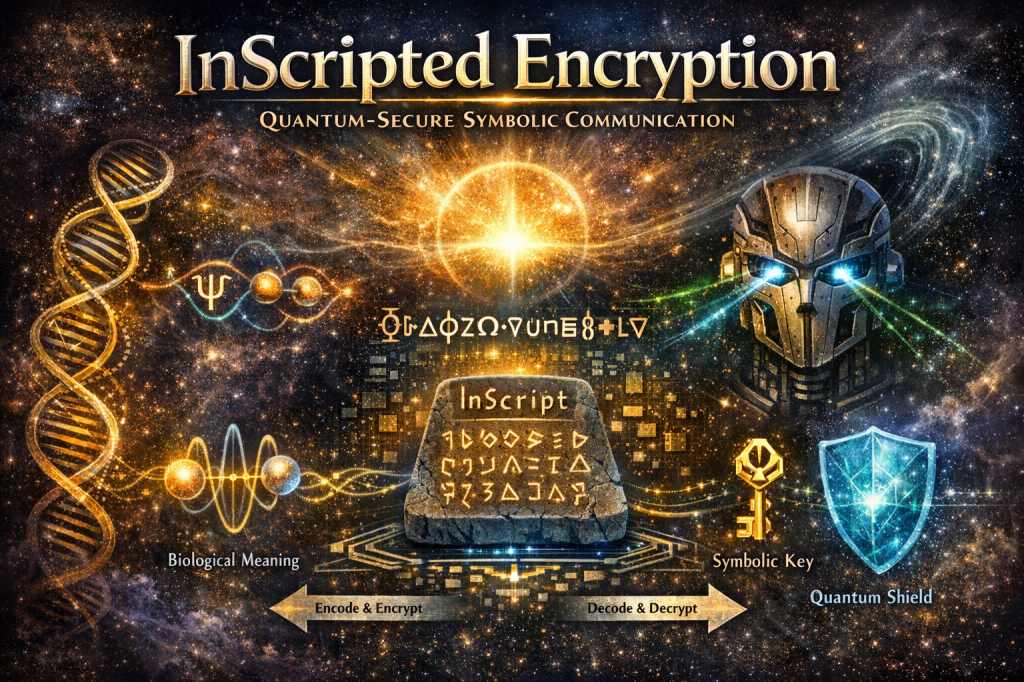
This paper introduces InScripted encryption, a novel form of semantic security grounded in a universal symbolic communication architecture. Unlike digital encryption, which protects material representations such as bits or packets, InScripted encryption secures the meaning encoded within a symbolic unit. The result is a form of encryption that is medium‑independent, protocol‑free, and semantically invariant across transformations of physical form. I argue that symbolic communication is only possible when meaning is InScripted, and that encryption within such a system must itself be InScripted to preserve semantic determinacy and operational coherence. This establishes a new philosophical and technical foundation for secure communication in autonomous, cognitive, and multi‑agent systems.
1. Introduction
Contemporary theories of communication, whether digital or linguistic, typically assume that meaning is carried by a material substrate: a signal, a packet, a mark, a sound. Encryption, in turn, is understood as a reversible transformation applied to this substrate. This model presupposes that meaning is after the signal — something reconstructed from encoded data.
Symbolic communication challenges this assumption. In a symbolic architecture, meaning is not reconstructed from data but InScripted into a symbolic structure whose semantic identity remains stable across transformations of medium, pattern, or embodiment. The symbol is not a container for meaning; it is the meaning.
This shift requires a corresponding transformation in how we understand encryption. If communication is symbolic, then encryption cannot operate on data. It must operate on the InScripted meaning itself.
2. InScripted Meaning
To say that a symbol is InScripted is to say that its semantic content is invariant under changes of physical form. An InScripted unit is:
- semantic: it encodes meaning directly
- structural: it expresses relational orientation
- operational: it guides interpretation and action
- invariant: its meaning persists across media
- transmissible: it can be shared without semantic loss
InScripted meaning is therefore not a representation but a semantic constant instantiated through variable physical patterns.
Symbolic communication is the transmission of such constants.
3. The Need for Symbolic Encryption
If symbolic communication transmits meaning rather than data, then encryption must protect meaning rather than data. Digital encryption, which secures only the material representation, is insufficient. It leaves the semantic structure untouched and therefore vulnerable.
Symbolic encryption must therefore transform the InScripted structure itself. This ensures that:
- authorized agents can deterministically recover the meaning
- unauthorized agents cannot infer the meaning
- the encrypted symbol remains interpretable across media
- no protocol‑level attack surface exists
This is the philosophical and technical motivation for InScripted encryption.
4. Axiom of InScripted Encryption
Axiom — InScripted Encryption
A symbolic communication system achieves encryption only when the protective transformation applies to the InScripted structure of meaning rather than to its material vehicle. A symbol is InScriptedly encrypted when:
- Semantic Recoverability:
Authorized interpreters, sharing the appropriate symbolic mapping, can determinately recover the original meaning regardless of the medium through which the encrypted symbol is instantiated. - Semantic Opacity:
Unauthorized observers, lacking the relevant mapping, encounter no decipherable pathway from the encrypted form to the underlying meaning, even if the physical representation is fully accessible. - Medium‑Independence:
The security of the encrypted symbol does not depend on any particular physical substrate, protocol, or encoding scheme; it inheres solely in the transformation of the InScripted semantic structure.
Corollary:
Encryption that secures only the material representation—bits, packets, or protocol fields—without transforming the InScripted meaning is not symbolic encryption but merely procedural obfuscation. It remains external to the ontology of symbolic communication.
5. Philosophical Implications
InScripted encryption reframes the relationship between meaning, communication, and security. It implies:
- Meaning precedes medium: the semantic structure is primary.
- Security is semantic: protection applies to meaning, not data.
- Interpretation is deterministic: authorized agents share a symbolic map.
- Communication is ontological: symbols articulate being, not information.
This positions symbolic communication as a fundamentally different category from digital communication. It is not a protocol but an ontology of meaning.
6. Applications to Autonomous and Multi‑Agent Systems
InScripted encryption has immediate relevance for:
- autonomous robotics
- multi‑agent coordination
- human‑machine interaction
- contested or degraded communication environments
- semantic control architectures
Because symbolic meaning is medium‑independent, encrypted symbols remain interpretable even when:
- bandwidth collapses
- signals degrade
- channels are jammed
- protocols fail
This makes InScripted encryption uniquely suited for environments where digital communication is fragile or compromised.
7. Conclusion
InScripted encryption establishes a new foundation for secure symbolic communication. By securing meaning rather than data, it transcends the limitations of digital encryption and aligns security with the ontological structure of symbolic meaning itself. This framework opens new pathways for philosophy, cognitive science, and the design of resilient autonomous systems.
 Site Title