Rodolfo Rojas
Abstract
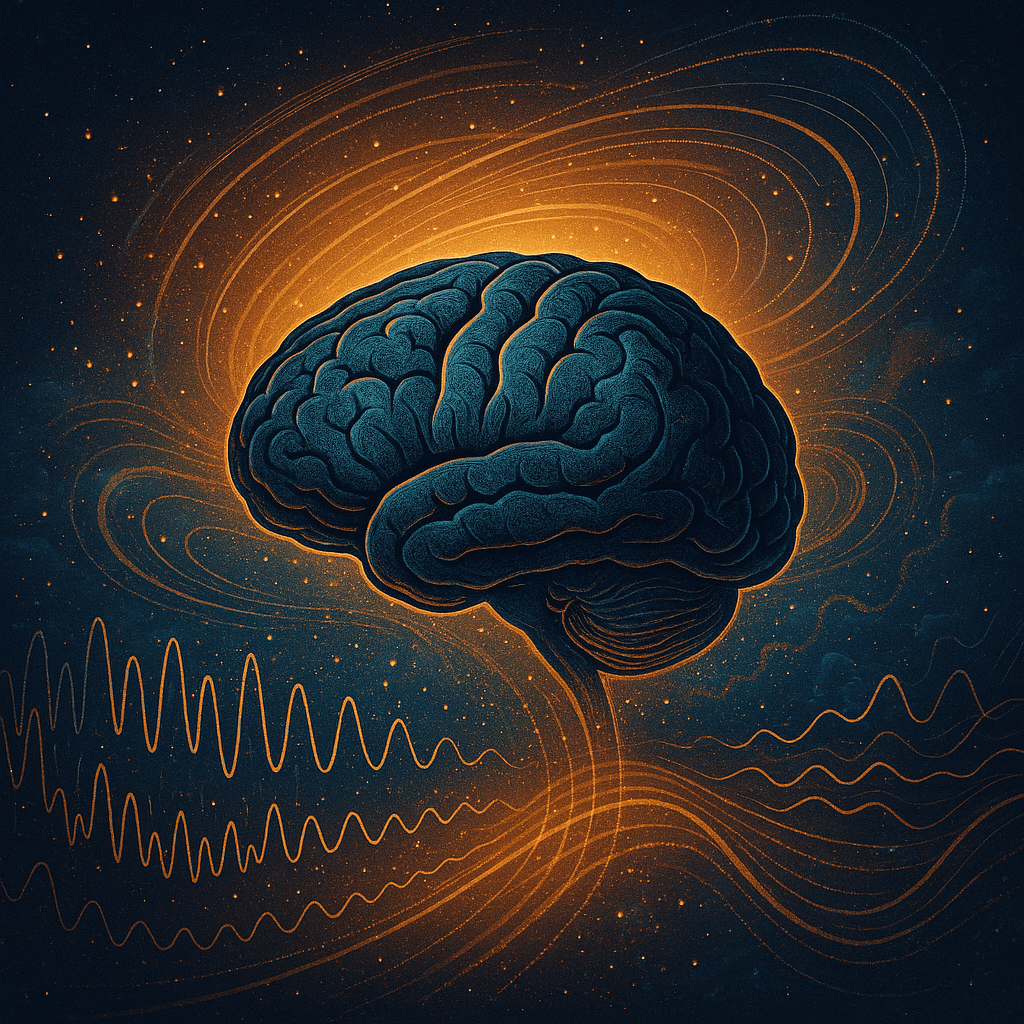
Neuroscience has traditionally assumed that the brain passively inherits the temporal structure of the external world. Recent empirical work challenges this view by demonstrating that neural systems generate their own temporal dynamics. Research on intrinsic neural timescales shows that different brain regions operate on characteristic temporal windows that shape how information is processed and integrated (Parkes et al. 2026). These endogenous timescales form hierarchical gradients across sensory and associative cortices, influencing the speed and depth of perceptual and cognitive operations (Cusinato et al. 2023). Additional work suggests that intrinsic timescales play a key role in both resting-state dynamics and task‑related processing, indicating that the brain actively constructs the temporal framework within which experience unfolds (Northoff et al. 2021). Despite these advances, neuroscience lacks a unifying account of how heterogeneous neural clocks yield the unified temporal flow characteristic of consciousness. I argue that these findings point toward a deeper principle: the organism generates a biological time that organizes neural dynamics and grounds the temporal unity of experience. This biological time is not reducible to physical time or to local neural timescales; rather, it is a global temporal field produced by the living system as a whole. I develop this proposal and explore its implications for the metaphysics of time, the philosophy of mind, and the limits of computational models of consciousness.
Keywords
intrinsic neural timescales; biological time; temporal experience; neural dynamics; consciousness; temporal unity; philosophy of neuroscience; metaphysics of time
1. Introduction
Philosophical and scientific accounts of time have long assumed that the temporal structure of experience is inherited from the external world. On this view, physical time—seconds, milliseconds, oscillations—provides the objective scaffold upon which neural processes unfold. Consciousness, in turn, is thought to reflect this external temporal order.
Recent developments in neuroscience challenge this assumption. Across multiple research programs, evidence now suggests that the brain does not merely measure external time. Instead, it generates internal temporal structures that organize perception, memory, and action. These findings raise a deeper philosophical question: What is the nature of the time that consciousness inhabits?
This article argues that contemporary neuroscience has uncovered fragments of an internal temporal architecture—intrinsic neural timescales, temporal integration windows, and population‑clock dynamics—but lacks a unifying framework. I propose that these findings point toward a more fundamental idea: the organism generates a biological time that provides the temporal unity of consciousness. This biological time is not reducible to external physical time, nor to the local timescales of individual neural circuits. It is a global temporal field produced by the living system as a whole.
2. The Scientific Landscape
2.1 Intrinsic Neural Timescales
Research in systems neuroscience shows that different brain regions operate on characteristic temporal windows known as intrinsic neural timescales (INTs). These timescales determine how long a region integrates information before updating its state. Sensory cortices exhibit short timescales, while higher‑order regions integrate over seconds or longer. These timescales are endogenous properties of neural circuits, not imposed by external stimuli.
Studies demonstrate that the brain “utilizes its own intrinsic neural timescales to process and actively shape the extrinsic timescales of the multiscale inputs it receives” (Northoff et al. 2021). This suggests that the brain imposes temporal structure on the world rather than passively receiving it.
2.2 Hierarchical Temporal Gradients
Temporal‑lobe structures exhibit progressively increasing intrinsic timescales, forming a fine‑grained hierarchy of temporal windows (Cusinato et al. 2023). This gradient supports the integration of fast sensory information into slower, more abstract representations. The existence of such gradients indicates that temporal processing is not uniform but structured across multiple levels of neural organization.
2.3 Fast–Slow Integration Across Networks
Recent work shows that the brain’s ability to shift between fast and slow patterns of activity depends on the coordination of regions operating on different internal clocks (Parkes et al. 2026). These internal clocks shape cognitive flexibility, memory, and decision‑making. The brain’s temporal architecture is therefore not a single clock but a dynamic interplay of multiple timescales.
3. The Philosophical Problem
Neuroscience has revealed a multiplicity of internal clocks:
• fast sensory timescales
• intermediate decision‑making windows
• slow integrative dynamics
• temporal drift in memory circuits
• population‑level temporal trajectories
Yet consciousness presents a unified temporal flow. How do these heterogeneous neural clocks yield a single, coherent experience of time?
Current scientific models lack a framework for:
• how multiple neural timescales are coordinated
• how subjective duration emerges
• how the organism maintains temporal coherence
• why consciousness has a unified temporal direction
This is the conceptual gap that motivates the proposal of biological time.
4. Biological Time
4.1 The Organism as a Temporal Generator
Living systems maintain coherence across billions of molecular events. This coherence requires a global temporal order that is not reducible to external time. Biological processes—metabolism, homeostasis, neural firing—unfold according to the organism’s internal temporal rhythm.
This rhythm is not a mechanical clock. It is a field‑like temporal structure generated by the organism’s ongoing activity.
4.2 Consciousness as Synchronization
Consciousness is not simply a sequence of neural events. It is the synchronization of neural dynamics to the organism’s biological time. This explains:
• why consciousness has a unified temporal flow
• why subjective time diverges from physical time
• why neural timescales vary yet remain coordinated
• why the organism maintains temporal coherence
Biological time is the hidden architecture that unifies the brain’s fragmented temporal processes.
5. Implications
5.1 Limits of Reductionism
If biological time is fundamental to consciousness, then attempts to reduce consciousness to neural computation are incomplete. Computation presupposes a temporal framework; biological time provides that framework.
5.2 Rethinking Time
This view supports a pluralistic temporal ontology:
• physical time (external)
• biological time (organismic)
• subjective time (phenomenological)
Biological time mediates between the physical and the subjective.
5.3 Artificial Intelligence
Artificial systems operate on external clock cycles. They do not generate biological time. This may explain why artificial systems lack the unified temporal flow characteristic of conscious organisms.
6. Conclusion
Neuroscience has uncovered compelling evidence that the brain generates internal temporal structures. But these findings remain fragmented. I argue that they point toward a deeper principle: the organism generates a biological time that unifies neural dynamics and grounds the temporal structure of consciousness. This proposal integrates empirical findings with a broader metaphysical framework, offering a new way to understand the relationship between life, time, and mind.
Bibliography
Cusinato, M., et al. (2023). Intrinsic neural timescales along the human temporal lobe. Journal of Neuroscience.
Northoff, G., et al. (2021). The brain and its time: intrinsic neural timescales are key for input processing. Nature Communications.
Parkes, L., et al. (2026). Brain regions run on different internal clocks to coordinate fast and slow signals. Rutgers University / Nature Communications.
 Site Title