Rodolfo Rojas
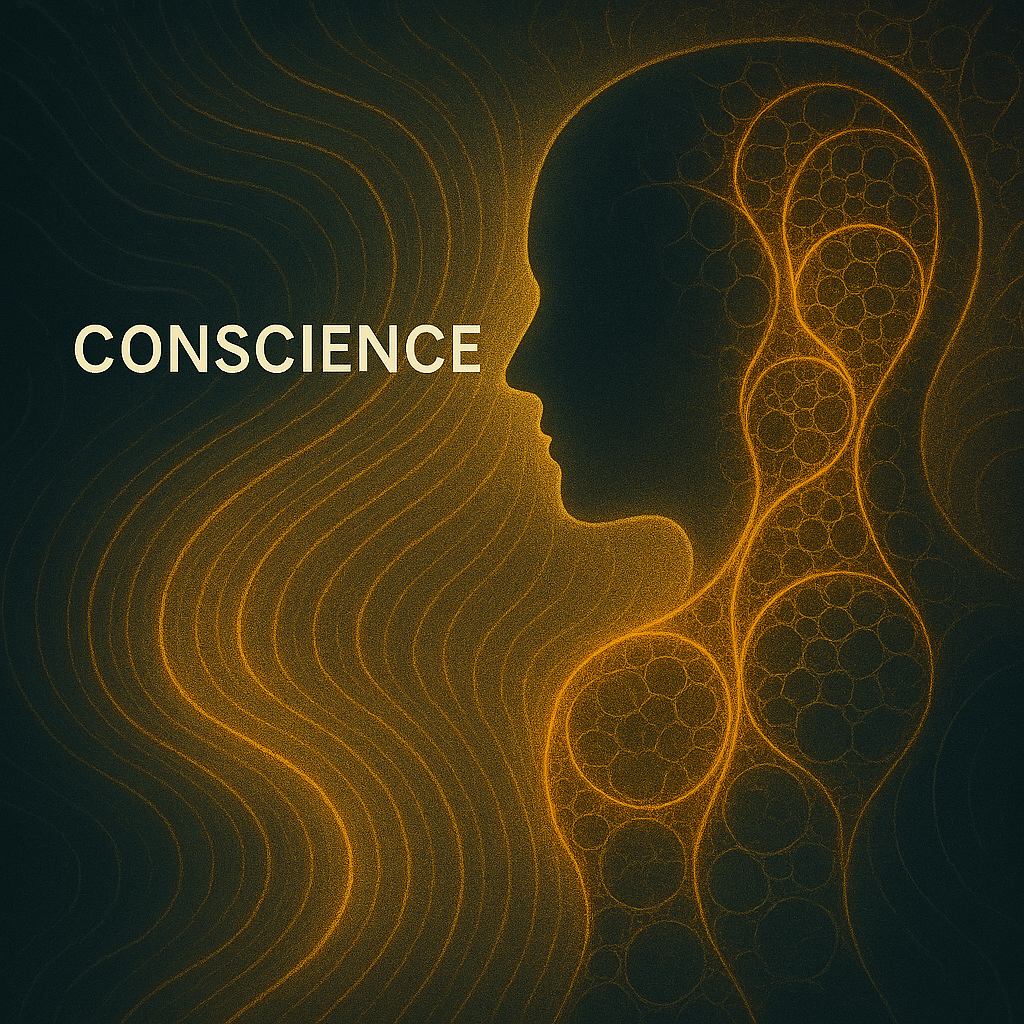
“Conscience is the ente’s evaluative architecture. It arises from coherence‑preservation, generates meaning, regulates behavior, and orients the organism toward survival, integration, and authorship. It is not morality, not emotion, not social conditioning, but the biological capacity to evaluate and reorganize the warp it inherits.”
“The ente is the biological generator of interior time. It arises from metabolic continuity, produces intervals, and from these generates patterns, learning, memory, identity, and agency. It is not matter, not mind, but the temporal architecture through which a living being becomes a self.”
Abstract
This article develops a biological metaphysics of conscience by grounding it in the ente’s evaluative architecture. Conscience, in this framework, is not a moral faculty, a cultural artifact, or a neural byproduct. It is the ente’s intrinsic capacity to preserve coherence, evaluate conditions, and reorganize its internal patterns in response to environmental change. I argue that conscience emerges with biological organization and is inseparable from metabolic continuity, temporal generation, and the ente’s identity across time. Conscience is the warp‑modifying engine that enables learning, adaptation, and agency. It is the biological foundation of meaning, responsibility, and self‑authorship. I distinguish multiple gradients of conscience — plant, animal, human, collective, and cosmic — each defined by the ente that generates it. This framework reframes conscience as a fundamental biological operation rather than a cultural or psychological construct, establishing a new metaphysical foundation for understanding agency, evolution, and the architecture of the self.
1. Introduction: Why Conscience Must Be Re‑Examined
Conscience is one of the most misunderstood concepts in philosophy, psychology, and religion.
It is often treated as:
• a moral compass
• a cultural imprint
• a psychological voice
• a social regulator
But these interpretations mistake content for capacity.
In this cosmology, conscience is not a set of rules or norms.
It is the ente’s evaluative architecture — the biological capacity to:
• preserve coherence
• assess conditions
• reorganize patterns
• generate meaning
• orient behavior
Conscience is not added to life.
Conscience is intrinsic to life.
Where there is an ente, there is conscience.
2. The Biological Foundations of Conscience
Conscience emerges when matter becomes a self‑maintaining system capable of:
• regulating internal conditions
• evaluating environmental changes
• preserving identity across time
• generating metabolic continuity
These operations require evaluation — and evaluation is the root of conscience.
Conscience is not a moral faculty.
It is a biological necessity.
Every ente must:
• distinguish beneficial from harmful
• maintain coherence
• respond adaptively
• reorganize internal patterns
This evaluative activity is conscience in its primordial form.
Thus:
Conscience begins with life, not with morality.
3. Conscience as the Ente’s Evaluative Architecture
Conscience is the ente’s capacity to:
• detect threats to coherence
• prioritize actions
• assign value to conditions
• regulate behavior
• generate meaning
• modify inherited patterns
These operations are not optional.
They are the mechanisms through which the ente persists.
Conscience is not something the ente has.
Conscience is something the ente is.
It is the ente’s evaluative mode of existence.
4. Conscience and Time: Co‑Emergence
Conscience and time arise together.
• Time is the ente’s internal organization of change.
• Conscience is the ente’s internal evaluation of change.
Where there is temporal continuity, there must be evaluative continuity.
Where there is evaluation, there must be temporal flow.
Thus:
• Time provides the continuity conscience evaluates.
• Conscience provides the evaluation that shapes temporal continuity.
Conscience is the warp‑modifying engine.
Time is the warp‑generating engine.
Together, they form the ente’s architecture of identity.
5. Conscience as Warp Modification
The ente inherits a biological warp — genetic patterns, reflexes, tendencies.
Conscience is the mechanism that:
• interprets these patterns
• modifies them
• reorganizes them
• transcends them
Conscience is the biological engine of self‑modification.
It is the capacity that allows the ente to:
• learn
• adapt
• change behavior
• generate new patterns
• create meaning
• author its own evolution
Conscience is the biological foundation of freedom.
6. Gradients of Conscience Across the Ladder
Each ente expresses conscience according to its organization.
Plant Conscience
Evaluative, chemical, distributed.
A slow, continuous assessment of conditions.
Animal Conscience
Sensorimotor, emotional, behavioral.
A rapid evaluation of threats, opportunities, and social signals.
Human Conscience
Symbolic, reflective, narrative.
A capacity for self‑interpretation, responsibility, and authorship.
Collective Conscience
Cultural, historical, civilizational.
A shared evaluative architecture that transcends individuals.
Cosmic Conscience
Integrative, planetary, unifying.
The evaluative coherence of a higher‑order ente.
Conscience is not one thing.
Conscience is many things — each generated by the ente that lives it.
7. Implications for Metaphysics
This view overturns classical assumptions:
• Conscience is not moral.
• Conscience is not cultural.
• Conscience is not psychological.
• Conscience is not neural.
Instead:
Conscience is the ente’s evaluative architecture — the biological foundation of meaning, agency, and self‑authorship.
This reframes metaphysics around the ente’s operations rather than abstract categories.
8. Implications for Science
Neuroscience must recognize that:
• neurons do not originate conscience
• brains amplify evaluative capacities
• conscience is not a neural artifact
• evaluation is intrinsic to biological organization
Biology must recognize that:
• evaluation is not external to life
• coherence‑preservation is an evaluative act
• metabolic continuity requires evaluative regulation
• conscience is an emergent property of living systems
This opens a new field: ente‑evaluative biology.
9. Conclusion: Conscience as the Ente’s Evaluative Identity
Conscience begins with the ente.
Conscience is the ente’s evaluative architecture.
Conscience is inseparable from time, identity, and agency.
Conscience is not moral, not cultural, not neural.
Conscience is biological.
Conscience is intrinsic.
Conscience is the ente.
 Site Title