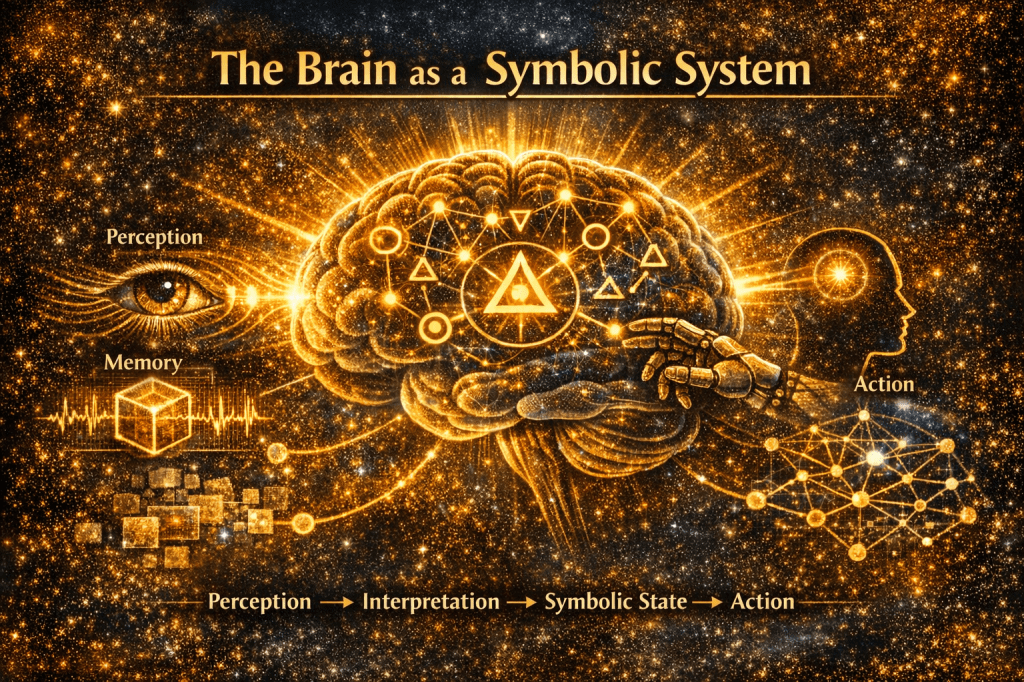
The human brain does not store information as words, images, or data. It stores symbols — stable patterns of neural activation that carry meaning within the internal ontology of the mind.
Every perception, memory, and intention is encoded as a symbolic configuration:
- spatial firing patterns
- temporal rhythms
- synaptic weight constellations
- distributed neural ensembles
These patterns are not linguistic. They are symbolic states, interpreted only by the brain that created them.
This is why thought is inherently private: the brain’s symbolic system is self‑referential, self‑interpreting, and naturally encrypted. No external observer can decode these symbols without access to the brain’s internal ontology.
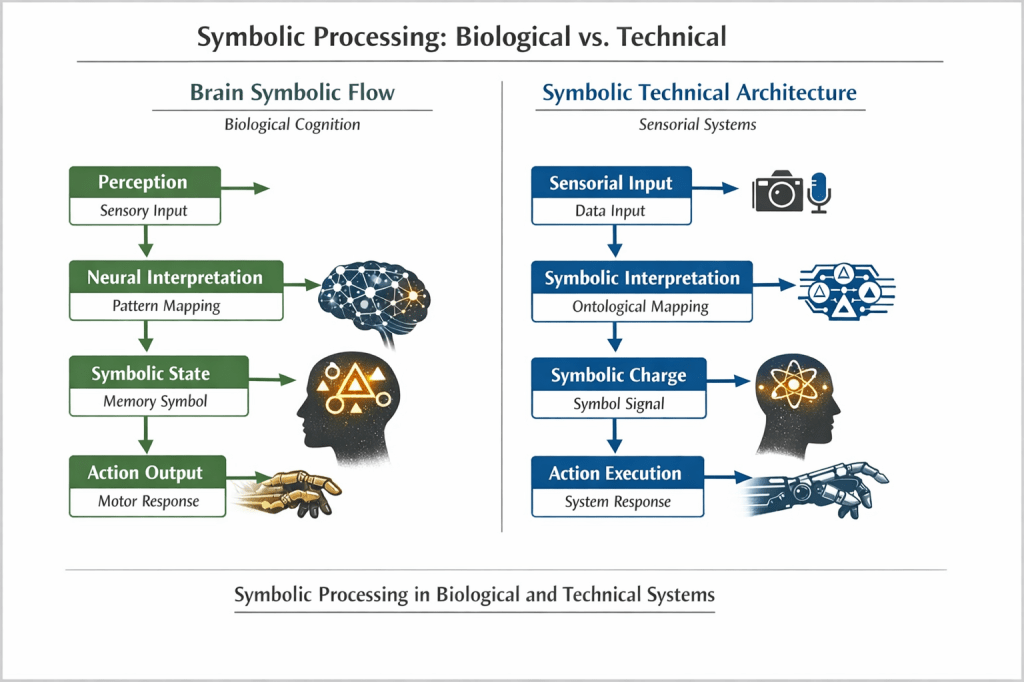
In this sense, the brain functions exactly like a sensorial entity:
Perception → Interpretation → Symbolic State → Action
This is the same structure that underlies the Symbolic Communication Architecture. Just as technical systems in this architecture coordinate through symbolic charge, the brain coordinates its internal processes through symbolic patterns.
The brain is not a computer processing data. It is a symbolic system generating meaning.
This biological insight is the foundation of symbolic communication: a universal architecture where meaning is not transmitted through language or protocols, but through symbols interpreted by sensorial structures.
 Site Title